Last month I had the pleasure of attending the National Diversity Officers in Higher Education conference in Seattle, also known as the NADOHE conference. I’ve been doing diversity work at Stanford for a decade, and while I have been keeping up with best practices through webinars, journal articles, and discussions with my wonderful Stanford colleagues (shout out to GDiSC and Doerr school team!), I had never attended a national conference. This year felt so important to be in community with fellow diversity officers as we’ve all seen the anti-DEI rhetoric that has emerged in legislative action and also within higher education policies.
Such rhetoric has me thinking about language and what DEI means to me. Diversity, Equity & Inclusion is about creating access, that is, creating opportunity for individuals from historically underrepresented groups to have a chance at competing in the workplace, in schools, and in any organization and institutions where we see societal inequalities play out. This is a chance at equal opportunity. Indeed, it’s the opportunity to go after the dream (the American dream or whatever version on that dream may be), a dream that we must recognize is not easily accessible to everyone. And inclusion is about creating a welcoming environment for all—a sense of belonging where you are invited to share your voice and contribute, and where you are seen and appreciated.
Unfortunately, in this cultural moment, there is currently a caricature version of DEI that runs through our mainstream news cycle. It’s a weaponized definition of policies and practices that have origins in Civil Rights legislature. However, the meaning of DEI sometimes gets morphed to create fear instead of a mutual appreciation or communal values that enhance the environment for all, especially within a multicultural democracy such as ours. Who doesn’t want to work or interact in a climate where there are equitable hiring and promotion practices, where we all can benefit from getting to know each other’s diverse perspectives and thus gain a greater appreciation for our distinct contributions and talents? This is the conversation that I was looking for at the 2024 NADOHE conference in Seattle and which I found with my fellow higher education professionals who also attended.
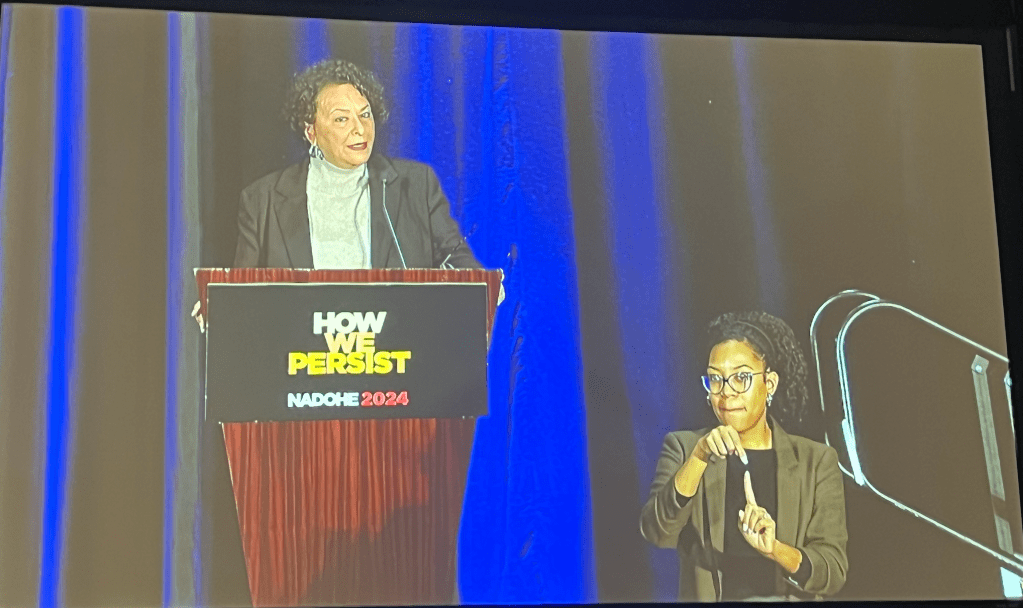
Ever the nerd who just wants to learn the latest research, I attended as many sessions as I could. The keynote from the president of NADOHE Paulette Granberry Russell, J.D was timely—she reminded us that the current attacks on initiatives that have origins in addressing inequities for all, especially for underrepresented individuals, are nothing new. Indeed, there have been ebbs and flows throughout American history and the arc toward a more just society has always moved forward even with its unexpected turns. She also mentioned that it is imperative for us to tell our story of what we are doing as higher educational professionals—let’s not waste our breath by reacting at stories that don’t represent our values, but instead, let us delineate those values and share what we care about and how we want to be a force for positive change for our academic communities.
I attended many other keynotes, workshops, and talks. I felt inspired by Professor and USC School of Education Dean Pedro Noguera‘s call for leadership to continue to showcase the importance of this work and to invite dialogue with those whose ideas may not agree with ours. I also learned about University of Illinois, Chicago’s best hiring practices/postdoc pathway programs for attracting diverse faculty to their campus, and also appreciated hearing about Rice University’s Engineering school approach to measuring the success of their DEI efforts through specific goals and metrics–something that we do here at our own Doerr School of Sustainability.
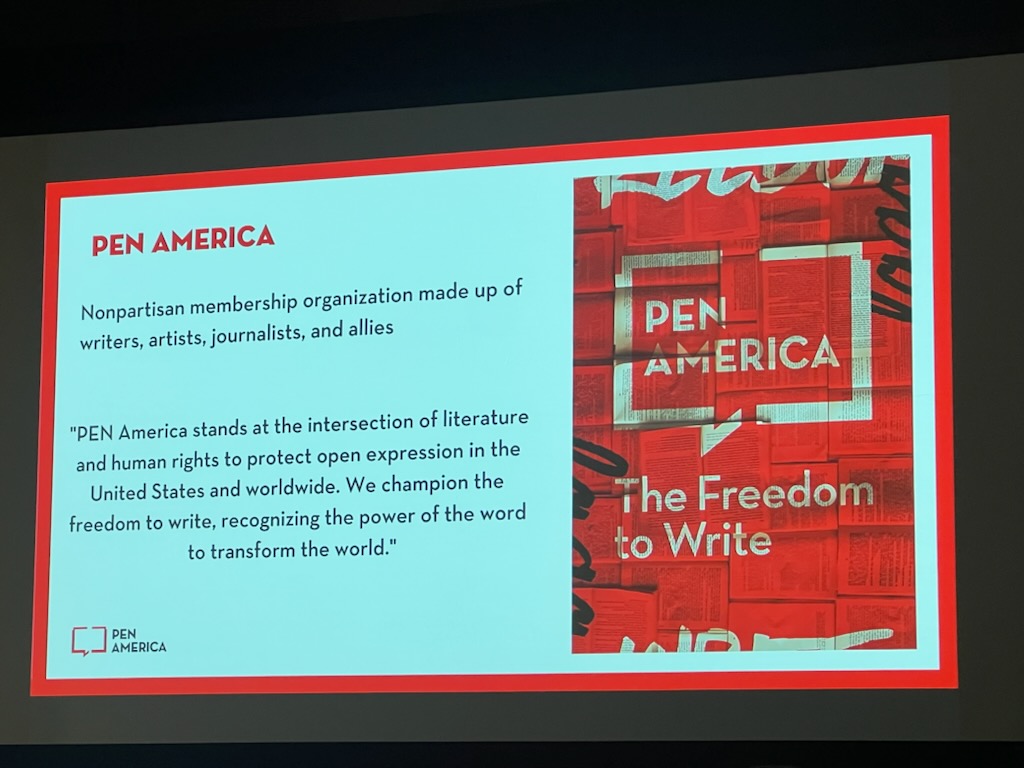
I also very much enjoyed the keynote talk presented by Kristen Shahverdian from the PEN America organization on how to cultivate nuanced and thoughtful discussion about Free Speech and academic freedom on college campuses. I appreciated that we were fully engaging with this topic of Free Speech since many people may think that to support diversity, equity, and inclusion is to support just one way of thinking and one narrative–but that couldn’t be further from the truth. The principles of DEI is to invite diverse voices, points of view, ways of thinking to the conversations, and while that may lead to discomfort and challenging dialogue, it is a dialogue nonetheless. Dialogue includes the exchange of ideas, but also presupposes that we listen as much as we speak, and that we are open to learning and changing our own points of view as much as we are building our own persuasive argument and claims.
In the last day of the conference, I was eager to learn more best practices and to be “in the know” about the latest DEI conversation that I could bring back to Stanford. I needed to make this trip and my attendance there useful and productive. But there was a moment of pause when I noticed on the conference schedule a session for Latina Higher Education administrators. It was a panel featuring three Latina higher education professionals and their testimonies/testimonios on what it was like to break barriers in academia. I paused when reading about the session because I wanted to attend but I also felt that I needed to continue to soak up the best practices and strategies of the other panels. As much as I espouse the values of being in community and finding belonging, here I was not initially seeing the importance attending this session meant for Latinas like myself. Instead, I was focusing on needing to be productive and learn what was happening in the field. I was drinking the “need to be productive” Kool-aid, even at a conference that was for my own professional development.
I challenged my initial reaction, however. Why is it that I tell students, staff, and faculty that I work with how important it is for them to find community/sense of belonging, yet, here I am and I’m telling myself the opposite? It almost felt like it would be a luxury to attend a panel that was about my personal and lived experiences in the academy. Hadn’t I processed those feeling years ago and with my close friends and confidants. I didn’t need that, I thought. However, I knew that I was operating from an outdated notion of what it meant to be a strong woman and a professional. I needed to take a step back and see the real need and desire there–I did want to attend that all Latina panel and just be with them. I had to challenge my binary thinking when it came to understanding what was productive. Getting a deeper understanding of myself as a Latina professional was important and productive. I was so used to being “the only one in the room” throughout the spaces I’ve travelled to over the years, that I didn’t know that I sometimes I don’t actually want to be the only one.
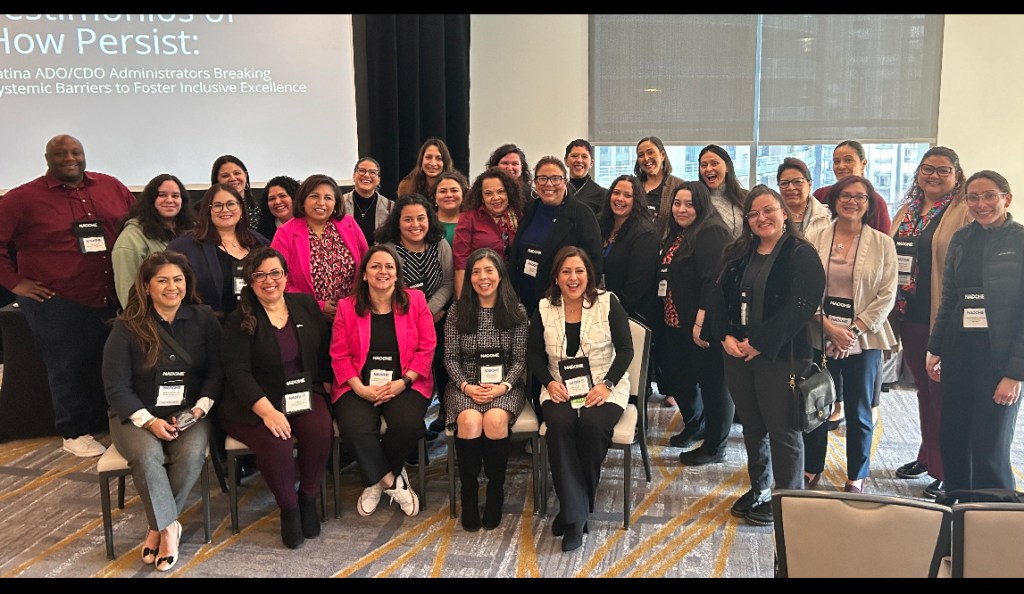
I entered the room and as I looked around in that mid-sized Grand Hyatt Hotel conference room and saw others who looked like me, dressed like me (hey hoop earrings!), spoke like me, I knew that I had made the right decision. I felt immediately relaxed–a feeling that I actually consciously remind myself to feel within a professional setting. The panel was about Testimonies and bearing witness to stories of three Latina administrators and what it took for them to navigate academia and climb up the ladders of the very hierarchical academic staff administrative structure.
I was moved by each story. The stories of how each woman had to confront the false beliefs and professional moments that questioned their authority, their reason for being there, their knowledge, and their wisdom. Moments when it’s sometimes easier to just lay low and do good work even if you’re also realizing that you are not being seen for your true potential and what you have to offer. All their stories touched on this, and I must admit I might be adding a bit of my own stories to theirs as I write this since I was finding that I was seeing myself through their panel.
As I told a Stanford colleague later in the week when I returned back to campus, I had met a community of professional women that I didn’t event know I needed. I had a strong group of friends from grad school and college, and wonderful colleagues, so I thought I was good in terms of finding a professional community. I was so used to “the only one” sensibility for so long, that it had become the norm to not expect this kind of visibility within a public setting. Usually, my Latina-ness is something that I live and express through personal relationships and friendships but not something that organically can be expressed in the workplace. I had learned a lesson in the importance of practicing what you preach. How could I tell others to find community and belonging if I didn’t do that for myself in my own role?
By the end of the panel, I had felt safe to say a few Spanish words here and there–a private language that is usually relegated to my family and close friends. I expressed my muchisismas gracias for sharing their testimonios with me. I felt the comradery in that moment. We all decided to commemorate the moment with a group photo. I stood in the back row of that group photo since I had a bit of a heel (I was sporting my new Vince suede boots) and I was feeling immense gratitude for not only being able to capture this moment but for finding more Critical Chicas doing their thing in the professional world. These fellow Latinas, women of color, and smart mujeres who I am sure had to overcome a lot and beat many odds to make it to that room and in that very moment.
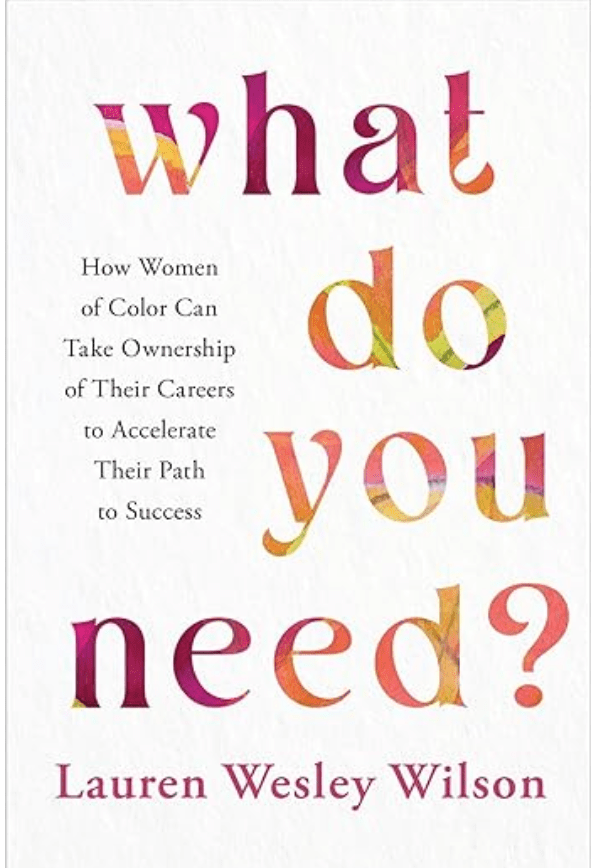
I left the NADOHE conference re-energized and with much gratitude that I was able to finally be in a place in my career where I could ask for what I needed to be the version of myself and in turn be the best for a DEI role that I do not take lightly. How did this chica from East Salinas make it Stanford and now have the priviledge of being part of one of most innovated sustainability schools in the world? As I write this today, I am feeling grateful and I am also excited about being more in touch with my myself and my values than ever before. On a serendipitous note, I actually received a book recommendation from a fellow Latina colleague/comadre on this topic of navigating the professional world as a women of color and had the chance to listen to a podcast about what we can do to control our professional destinies. The book is aptly called What Do You Need? By Lauren Wesley Wilson.
So what’s the Critical Chica takeaway? Just take a pause and you might just find that community you didn’t even know you were looking for or needed. xoxo LC

 Critical Chica