
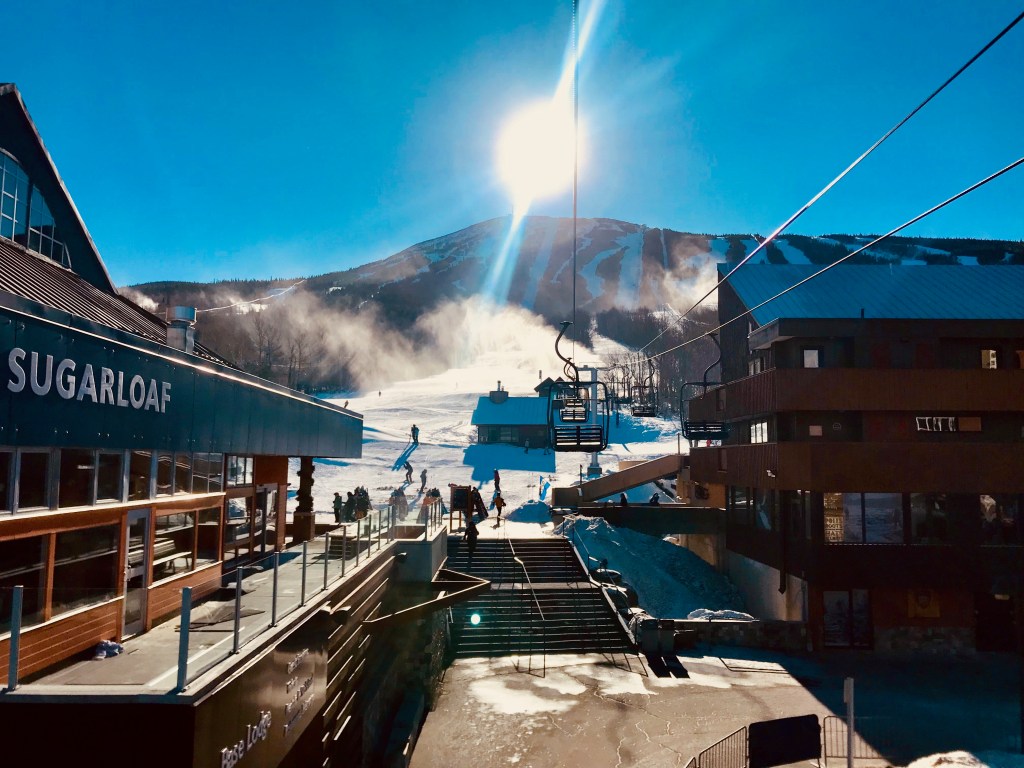
In December 2018 I travelled to Maine for a ski trip. When crossing the Maine state border, I was struck by a sign that read: “Maine. The Way Life Should Be.” Wow. Now that was a bold statement. Yet it left me intrigued to know more about this idyllic lifestyle. Could these Mainers know something about enjoying the good life that had escaped me? One that is vastly removed from the status-seeking and work-obsessed culture that I’m surrounded with in Silicon Valley?
I thought about this while sitting in a packed SUV next to my 10-year-old nephew. There were six of us in the car and we were en route from Long Island to Sugarloaf Ski Resort in Carrabassett Valley Maine for a Christmas family vacation. My brother and his family go skiing every year and this year I would join them and finally have the chance to see what skiing was all about. I had tried skiing once two years before in California but only stayed in the bunny slope. This trip would be different since I had plans to venture beyond the children’s area. The trip would also allow me test out my brother’s proclamation that I would learn a lot about myself while skiing (as he did himself when he first picked up the sport upon moving to the East Coast years ago). Was there a lesson about “the way life should be” in learning how to conquer the mountain during a ski trip?
One of the reasons why I sensed my brother was eager to get me skiing and was also excited to organize this Christmas family vacation is that skiing is not simply a winter sport, but an entrée into a culture that was unlike anything we were exposed to while growing up in California. Despite the fact that my Golden State is known for hiking, skiing, and surfing and other fun outdoor activities that you see in those “visit California commercials” that feature beloved 49er quarterback Joe Montana, that wasn’t the California I grew up in. In Salinas, an agricultural town that was a combination of farm town mixed with suburbia, I spent plenty of childhood summers rollerblading, playing basketball, and participating in the ingenious neighborhood sport of sledding down an undeveloped golden poppy-filled hill on old cardboard boxes (we lovingly called this recreational area “cardboard hill”). The Lake Tahoe or Big Bear skiing scene was far from my imagination.
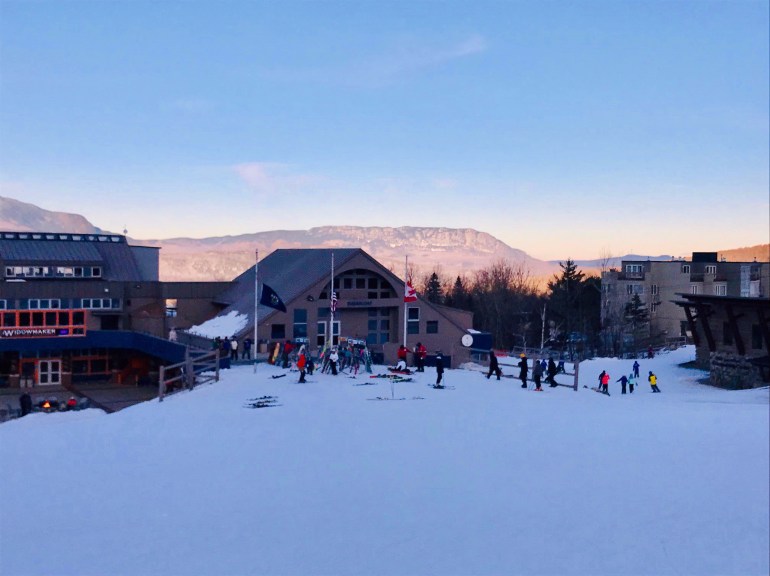
The Lodge. Where Apre Ski activities abound.
The sport also didn’t pique my interest since I didn’t necessarily have the need to look for a thrill-seeking activity. When you grow up in a neighborhood where gangs and drive bys are the norm, you’re not exactly in short supply of living on the edge. The feeling that something bad might happen was unfortunately a feeling that my friends and I were familiar with. It probably also spurred my love for some of the edgiest of West Coast Hip Hop of the 90s, but it also created within me cautious behavior that kept me safe and studious for many years while also holding me back when it came to taking risks. Also, I early on received the cultural message that as a woman, the notion of hanging out late on the streets was dangerous and out of the question. You couldn’t be too risky or risqué.
So, as you can see, I had missed out on some quintessential middle-class sports and other modes for managing risk and fear that competitive athletic experiences could offer. I had never taken ballet lessons nor participated in summer camps. It seems that I’ve been catching up on middle-class sporting experiences since then, picking up tennis and yoga along the way, and even trying CrossFit at one point. Another form of FOMO I suppose? But what was I missing out on? Was I missing out on some formative athletic experiences that would have prepared me better for the world or would have instilled in me a desire to explore and conquer the world? I had to find out. Hence the much-hyped family ski trip to Maine.
Well, I immediately learned that skiing is expensive. It takes a lot of resources to fund such a trip: from having the proper vehicle that can take you to the mountains, to buying the necessary equipment and vestiges. You’ll need high-quality ski pants, a waterproof jacket, ski goggles, gloves, and warm interior clothing. When you add all these items together, especially from brands like The North Face, Patagonia, and Roxy, we are talking at least $300. Renting ski equipment runs you an average of $70 dollars a day and then another $100 for a lift ticket. It’s not surprising that skiing originated with the European aristocratic and elite classes who gravitated to the Swiss Alps. But there is one way to address the wardrobe issue: take thee to the outlets!
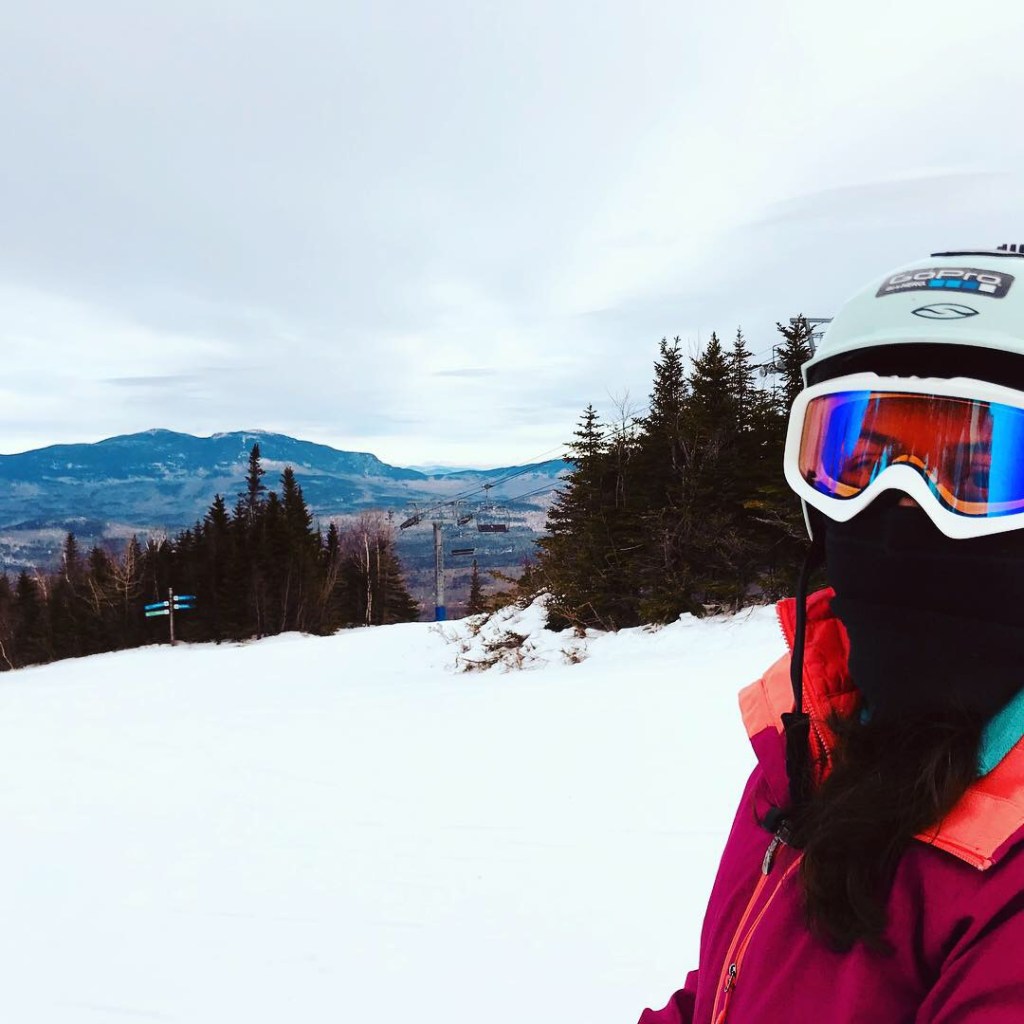
Completely covered up in my ski gear. The 18 degree weather actually motivates you to start skiing as soon as possible. No time for dilly-dallying.
Once you clad yourself in this winter warrior armor, reminiscent of the storm trooper from Star Wars, you feel at liberty to not only embrace but revel in the harshness of the winter landscape and the unforgiving 18-degree weather of the Northeast. Your ski boots lift you up a few inches above the snowy ground, only so you can slice through the icy surface when walking up to the lift. Aside from feeling like part-equipment and part human, you find that the goggles and face mask give you a certain anonymity that allows you to simply focus on the task at hand. You feel strong and athletic when you carry your skis toward the lift or cross-country ski (where you shimmy your legs and hips) to cut across a hill. You are all skiers on the mountain, free and strong, momentarily leaving your social identities at the lodge.
“Momentarily” is the imperative word here, however.
It’s no secret that there are very few people of color on the slopes. In her article “The Unbearable Whiteness of Skiing,” Annie Gilbert Coleman provides a historical overview of the sport in the United States, from the European skiing culture reproduced in places like Vail to examining how local communities of color in Colorado and in New Mexico contribute to the industry’s invisible labor while also making interventions within the sport, such as the Mescalero Apache Tribe who created the Ski Apache Lodge in New Mexico. Outside Magazine featured an article on how the Doug Coombs Foundation has created programs to introduce skiing to the Latino families in Jackson Hole, Wyoming who make up a large part of the service workers in this resort area. Anthony Kwame Harrison writes about the work that African Americans have done since the Civil Right Era to integrate skiing through the founding of the National Brotherhood of Skiers or by creating Black Ice weekend that usually takes place during MLK weekend. There are also the children of immigrants in the U.S. who are helping to change the face of skiing and snowboarding, including Robby Franco, the Mexican American from San Jose, CA who skied for the Mexico team in the PyeongChang Olympic games, and also the Olympic gold medalist Chloe Kim who won the the Women’s Halfpipe finals in South Korea as well. She is the youngest woman to win an Olympic medal in snowboarding and her love and passion for the sport was fun to watch during the games.
One of the reasons why people of color are not hitting the slopes may be for financial and wealth reasons (indeed, the median income of skiers is in the six figure range), but it is also cultural: skiing is simply one of the least diverse and integrated sports out there, which may explain why even upwardly mobile minorities may still choose other vacation activities. Upon arriving to The Sugarloaf Ski resort in Maine, I discovered the distinct behavioral codes inside the social milieu of the ski lodge and on the mountain. It was a revelation to me that you can leave your ski boots on when entering the lodge and restaurants—you didn’t have to take them off and put on your normal day boots. How convenient! But also how messy!
I also learned that when you go on a run you are expected to give the right of way to those ahead of you. And, it’s also a courtesy to let your lift partner know where you will turn after you unload and it’s also not uncommon to share the lift with a complete stranger (your chit-chat game better be strong). However, the social identities that we thought we left at the ski lodge doors quickly come back in those moments when you’re no longer just a helmet with goggles, but when you start meeting others. When I took the adult 3-day beginning ski lessons (which is totally worth it by the way) and met the instructors, I had to get really good at repeating my name since the instructors had a hard time pronouncing it. Is it “Lupus?” one of the instructors had asked.
I wasn’t sure if the instructor knew that she was actually referring to an autoimmune disease or if she was distracted by the larger task at hand of teaching us how not to die on the slopes. But I couldn’t help but think that if there were more Latinos out there with me in the Carrabassett Valley mountains perhaps such moments would happen less.
You learn to correct the instructors and navigate these moments for the opportunity to feel the rush of conquering the mountain. My mountain would be in the “green” level, which is the color that indicates beginner or easy. With the guidance of my friendly ski instructors who taught me how to finally make an “S” shape with my skis while going down the hill, I had completed a couple of runs with my group without falling. I had learned how to ski beyond the bunny slope and it felt great. All I had to do was just stay in this area for the next couple of days and I would be fine.
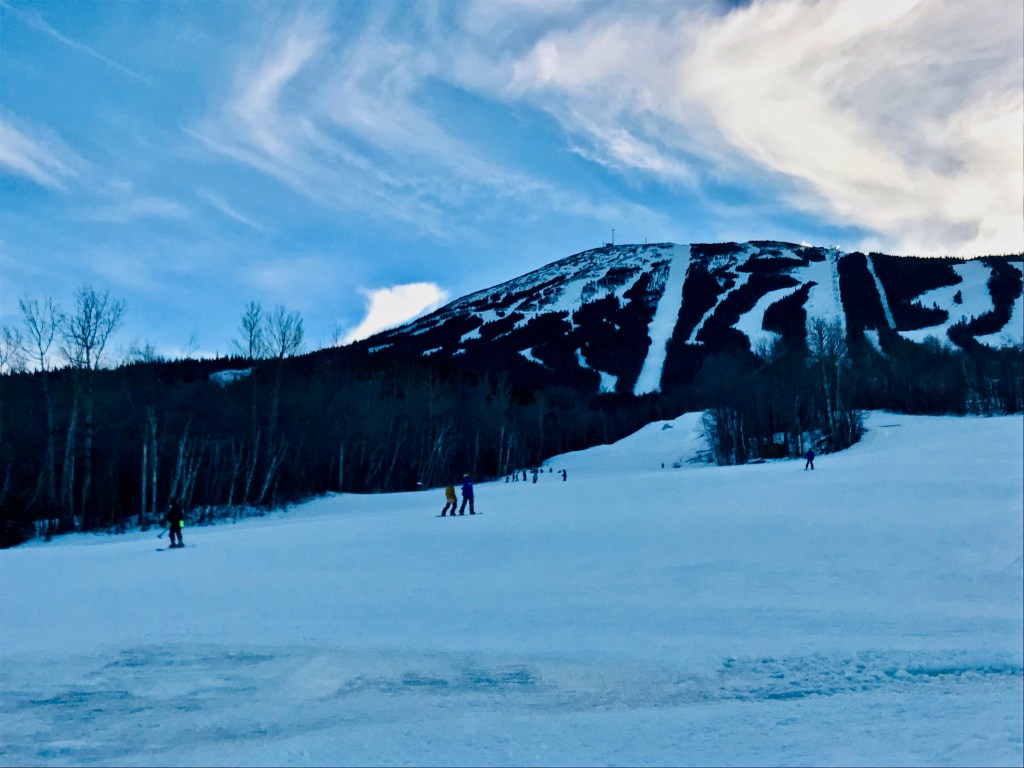
The mountain. Yet to be conquered.
Of course I didn’t just stay in that area since one could argue that the whole point of skiing is to advance to the next level and see more of the mountain. Mind you I could have done this by going to the next green level but my brother thought that the next day I would be ready for a green/ blue run on the West Mountain trail. I was up for rejoining my family on their ski runs because I was still riding high on my “I’m beyond the bunny slope” status. It was going to be just like the first day. Or so I thought.
But as we approached our spots at the West Mountain trail and I saw before me a view of the Carrabassette Valley that I hadn’t seen before, with the brown splotches of trees lining the snowy hills, I realized that this was going to be long ride down. An intense primal fear gripped me, making me forget my beautiful surroundings and leaving me with only one thought reverberating intensely through me: “How am I supposed to get down there?!” I knew it wasn’t impossible but the fear of the unknown was overwhelming. Was I going to get hurt along the way? Am I prepared enough to do this? What will happen as I start descending the mountain? At this point the entire family is waiting for me to just go, urging me to make the “S” letters as I skied down the mountain. The fear is just too much to bear to the point that I start tearing up. Mini panic attack ensues.

Soon a collective effort to help me was placed in motion. As if they had practiced this before, my niece and nephew (who are excellent skiers by the way) positioned themselves to the right and left of me, standing in what would be different parts of the letter “S” I was supposed to draw with my skis. While my sister-in-law encouraged me to start, my brother is waiting down the hill shouting “Con Huevos!” This is the Mexican version of “just do it!” which specifically translates to “with balls.” Using this gendered discourse to encourage me, even if done with a hint of irony, my brother was urging me to just do it.
You don’t exactly trust that it will be smooth ride going down. Instead you sense that you will maybe fall, it will hurt, and that you will somehow be okay just like everyone else who propels their bodies down the mountain. There’s nothing like standing at the top of the mountain and looking down a steep precipice to force you to learn how to trust yourself. Soon I zoned out the “Con Huevos!” shouts of encouragement from below the mountain, told myself that I needed to be okay with the possibility of getting hurt, took a deep breath, and went for it. Slowly but surely I went down the mountain focusing on each “S,” skiing toward my niece and nephew on opposite sides of the mountain, controlling and decreasing my speed as I skied down.
And of course I fell a couple of times and the fear didn’t fully dissipate, but I also learned what it meant to work through fear while reckoning with my own limited self-talk. Upon the third major fall down the mountain, I had declared to my brother in a moment of frustration, “I just can’t do it!” But as soon as I said that I couldn’t do it, I knew that this kind of mentality would not be helpful for me in order to get to my destination. “Don’t ever say you can’t do it!” my brother responded. I had to check myself before I wrecked myself, as Ice Cube would say, and there wasn’t any time for self-pity or negative talk.
And as I continued to fall down more times during that ski trip, including on mountain trails where I was sliding on ice (damn you Whiffletree!), I did learn a few things about trusting yourself. You didn’t need “huevos” or even the absence of fear to get down that mountain, you just needed to trust yourself that you will figure it somehow—even if you get hurt along the way. And, strangely enough, it took this skiing trip to Maine to remind me that I had been confronting fear well before I discovered expensive thrill-seeking sports. We confront fears and take risks in our own lives on a daily-basis, whether that be in the form of taking up a new sport, rollerblading in the hood, applying for that dream job or dream school, pitching your idea at work, or sticking up for you yourself and others. The problem is that life is not like a groomed mountain, a safe space to take risks and venture into new paths, but everyone (no matter where you come from) should at least have the chance to feel that they can confidently take chances when it comes to their own metaphorical mountains.
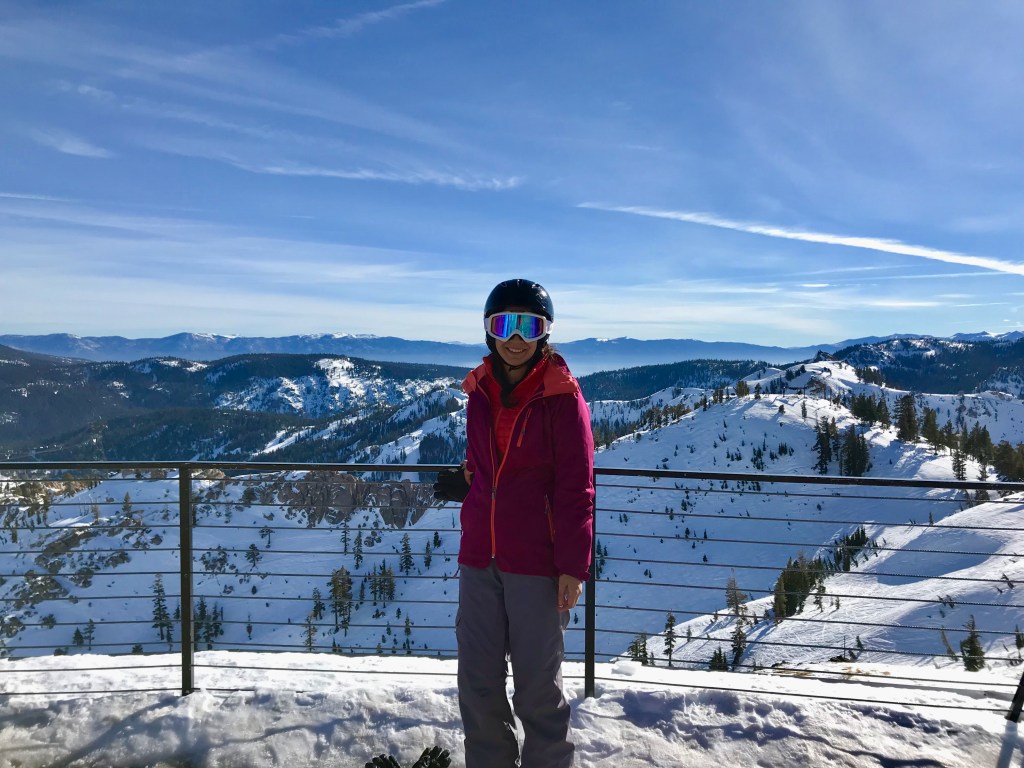
Months later I made it to Squaw Valley, Lake Tahoe. #Latinxontheslopes #skiingmexicans

 Critical Chica